Posts

Showing posts with the label paleoart

Remembering "Walking With Dinosaurs"
Image
  Being aware, through my favorite online sources on paleontology and paleoart, of the recent release of season two of the documentary series Prehistoric Planet , and having just taken a quick glance at the high production values and stunning visual effects, has made me remember the first series of this kind to be ever released, and what a big deal it was back then. Of course I’m talking about the BBC’s Walking With Dinosaurs , produced by Tim Haines, narrated by Kenneth Branagh (or Avery Brooks i n the version broadcast in the USA) and released in late 1999 or early 2000, depending on where you lived . At the time, the most convincing dinosaurs we had ever seen on a screen were those created by Industrial Light and Magic and Stan Winston’ s Studio for the Jurassic Park movie (which just turned 30, by the way, dating from 1993) and its sequel The Lost World (1997), both works of fiction that, despite showing relatively accurate and highly believable dinosaurs compared to pre...
Mary Ann's Teeth

Image
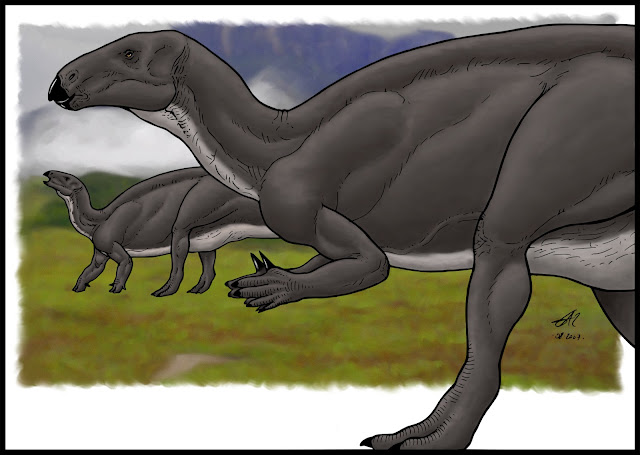
  As we already saw , Megalosaurus was the first dinosaur to ever be described by science back in 1824. It was also the first evidence that big predatory reptiles had once walked the land (giant marine reptiles had already been discovered before, with Ichtyosaurus being described in 182 1 and Mosasaurus in 1822 ) . T he n in 1825 another paramount discovery would follow when British physician, geologist and paleontologist Gideon Mantell named and described Iguanodon (“iguana tooth”) based on several teeth and an incomplete skeleton. This time it was clear that this new prehistoric saurian was, unlike Buckland’s Megalosaurus , a herbivore. Or at least it was to Mantell, who very cleverly identified its remains, especially its teeth, as those of a huge plant-eating reptile from the Mesozoic era . Unfortunately for him, not every one of his peers agreed at first. French anatomist George s Cuvier identified the teeth as those of a rhinoceros from the Tertiary , an opinion that ...

Buckland's Big Lizard

Image
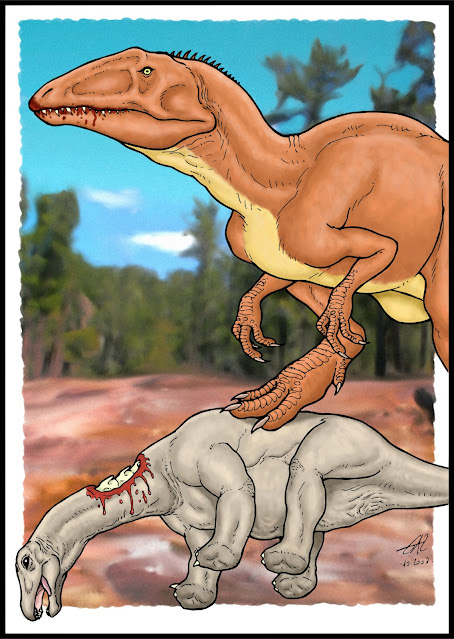
  Megalosaurus , once a staple i n every dinosaur book or publication you could find, has been gradually overshadowed by other, better known predatory dinosaurs, to the point that it is very rarely mentioned nowadays in dinosaur books and related media. There may be many reasons for that, but the main one is probably that, almost 200 years after it was initially described, it is still a very poorly known dinosaur due to the scarce remains available. Soon after its discovery in England in the early 19 th century, the genus became a sort of “wastebasket taxon” into which pretty much any other theropod dinosaur from anywhere in the world was thrown. Because of this, at one point more than 40 different species of theropod dinosaurs were assigned to the genus Megalosaurus , with some notable ones later reclassified as the now much better known Allosaurus , Ceratosaurus , Carcharodontosaurus , Torvosaurus , Eustreptospondylus , Dryptosaurus and Dil o phosaurus , among many others. O...

"Clever Girl"

Image
    It’s become simply unavoidable to reference Jurassic Park whenever this particular dinosaur is brought up in a conversation , for a number of reasons. First of all, it’s that movie (and to a lesser extent the original novel) that introduced Velociraptor to the general public and made it a pop culture icon. One, however, that has little to do with the real animal based on what is known about it. The film’s portrayal is extremely inaccurate and intentionally exaggerated, as t he y needed a vicious, physically intimidating and uncannily intelligent villain to generate enough tension in the audience. So, instead of changing the animal’s traits until they made it unrecognizable, as works of fiction tend to very often do, they just switched the creature for another one and kept the Velociraptor name because, you know, it sounds cool. But the animal they chose to call by that name in both the movie and the book is actually a bigger, North American relative of ...